What is Biological flows?
Biological fluid Dynamics (or Biofluid Dynamics) involves the study of the motion of biological fluids (e.g. blood flow in arteries, animal flight, fish swimming, etc.). ... It can be either circulatory system or respiratory systems.

Biofluid dynamics may be considered as the discipline of biological engineering or biomedical engineering in which the fundamental principles of fluid dynamics are used to explain the mechanisms of biological flows and their interrelationships with physiological processes, in health and in diseases/disorder. It can be considered as the conjuncture of mechanical engineering and biological engineering. It spans from cells to organs, covering diverse aspects of the functionality of systemic physiology, including cardiovascular, respiratory, reproductive, urinary, musculoskeletal and neurological systems.
The usefulness of the subject can also be understood by seeing the use of Biofluid Dynamics in the areas of physiology in order to explain how living things work and about their motions, in developing an understanding of the origins and development of various diseases related to human body and diagnosing them, in finding the cure for the diseases related to cardiovascular and pulmonary systems.
Basic Principles of Fluid Dynamics:
A fluid is defined as a substance that deforms continuously under application of a shearing stress, regardless of how small the stress is. Blood is a primary example of a biological fluid. Air can also be considered as biological fluid as it flows in lungs and the synovial fluid between the knee joints is also an example of a biological fluid. Types of Fluids
Fluids can be classified into four basic types. They are:
- Ideal Fluid
- Real Fluid
- Newtonian Fluid
- Non-Newtonian fluid


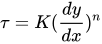
Thixotropic Fluid: Its viscosity decreases with stress over time. Example - Honey – keep stirring, and solid honey becomes liquid.
Rheopectic Fluid: Its viscosity increases with stress over time. Example - Cream – the longer it is whipped, the thicker it gets.
Shear Thinning Fluid: Its viscosity decreases with increased stress. Example – Blood, Tomato sauce.
Dilatant or shear thickening Fluid: Its viscosity increases with increased stress. Example – Oobleck (a mixture of cornstarch and water), Quicksand.
A Bingham plastic is neither a fluid nor a solid. A Bingham plastic can withstand a finite shear load and flow like a fluid when that shear stress is exceeded. Toothpaste and mayonnaise are examples of Bingham plastics. Blood is also a Bingham plastic and behaves as a solid at shear rates very close to zero. The yield stress for blood is very small, approximately in the range from 0.005 to 0.01 N/m2.
Reynolds number of the flow is defined as the ratio of inertia forces to viscous forces.
The Cardiovascular System
The Heart, arteries, and veins (a network of tubes to carry blood) constitute the cardiovascular system or circulatory system of our body which transports the blood throughout the body.

The heart can be thought of as a muscular pump, consisting of four chambers, and pulsatile muscles which pump and circulates the blood through the vasculature. Arteries, arterioles, capillaries, venules, and veins make up the vasculature. The cardiovascular system circulates about 5 liters of blood at a rate of approximately 6 L/m. The pulmonary and the systemic circulations are the two parts of the vasculature. The pulmonary circulation system consists of the network of blood vessels from the right heart to the lungs and back to the left heart. The rest of the blood flow loop is called systemic circulation system.
The process of gas exchange, that is, exchange of carbon dioxide with oxygen in the lungs is the main function of the pulmonary system. The de-oxygenated blood from the right ventricle is pumped to the lungs where the capillaries surrounding the alveole sacks exchange carbon dioxide for oxygen. The red blood cells and the hemoglobin present in the blood, which is the main carrier of oxygen in the blood are responsible for this exchange of gases before they are carried to the left ventricle of the heart. The systemic circulation is responsible for taking the oxygenated blood to various organs and tissues via the arterial tree before taking the deoxygenated blood to the right ventricle using the venous system (a network of veins). Arteries carry the oxygenated blood while the veins carry the deoxygenated blood.
Applications of Biofluid Dynamics
Biofluid Dynamics refers to the study of fluid Dynamics of basic biological fluids such as blood, air etc. and has immense applications in the field of diagnosing, treating and certain surgical procedures related to the disorders/diseases which originate in the body relating to cardiovascular, pulmonary, synovial systems etc.
The different types of cardiovascular diseases include Aneurysms, Angina, Atherosclerosis, Stroke, Different types of Cerebrovascular disease, Heart Failure, Coronary Heart diseases and Myocardial infarction or Heart attacks.
The Computational Fluid dynamics (CFD) models prepared through software, of the arteries, veins etc. not only lead to the identification of properties of flowing blood inside arteries but also changes in viscosity can be identified which may be the result of certain underlying disease/disorder.
Moreover, the stress concentration and the distribution of stresses in different biological systems carrying fluids can also be identified. This has led to a greater degree of assistance to biomedical engineers in recognizing the cause of certain diseases and thus they can easily search for the method of cure for that disease/disorder.
Also, this has led to a greater degree of good research in the fields of biotechnology, Bio-Mechanics etc.

